Variational adaptive Gaussian decomposition: Scalable quadrature-free time-sliced thawed Gaussian dynamics
Abstract
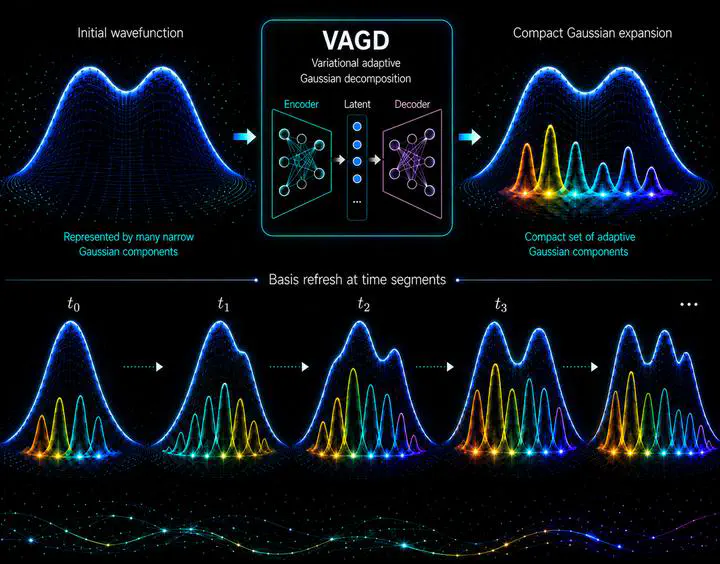
Time-slicing has emerged as a strategy for incorporating semiclassical propagation into real-time path integral formulation and recovering full quantum dynamics. A central step is the decomposition of a time-evolved wave function into a superposition of Gaussian wave packets (GWPs). Here, we introduce a quadrature-free variational framework for GWP decomposition, reformulating it as an optimization problem in which the GWP parameters are chosen to maximize the overlap with the time-evolving wave function. An autoencoder–decoder neural network is used for this optimization, with the representation being adaptively reoptimized during propagation. Each wave packet in this decomposition represents a localized patch of the underlying semiclassical manifold, while retaining full correlations between all degrees of freedom. This variational adaptive Gaussian decomposition (VAGD) approach yields a compact Gaussian expansion, providing a scalable route to time-sliced semiclassical quantum dynamics. While general, applying VAGD to facilitate time-slicing of thawed Gaussian dynamics allows a route to improving the semiclassical treatment to the full quantum mechanical result in a systematic manner.
Rahul Sharma
Graduate Student

Amartya Bose
Reader
My primary research interests are in developing physically motivated computational approaches for simulating non-equilibrium quantum dynamics of large systems in a condensed phase.