Routes of Transport in the Path Integral Lindblad Dynamics through State-to-State Analysis
Abstract
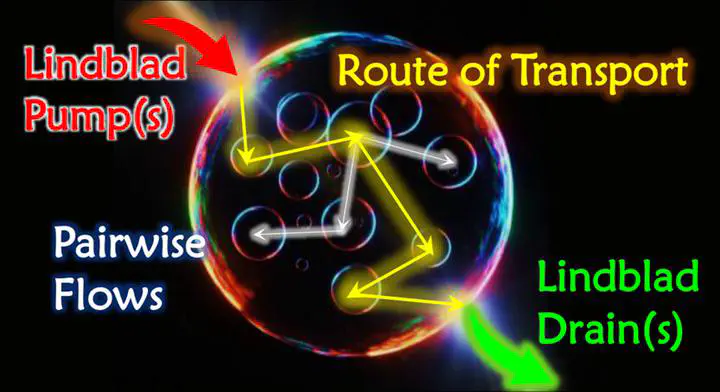
Analyzing routes of transport for open quantum systems with nonequilibrium initial conditions, such as exciton transport aggregates, is extremely challenging. The state-to-state approach [A. Bose, and P. L. Walters, J. Chem. Theory Comput. 2023, 19, 15, 4828–4836] has proven to be a useful method for understanding transport mechanisms in quantum systems interacting with dissipative thermal baths. However, real systems are often exposed to processes that may lead to either increase or decrease of the number of excitations in the aggregate. Such pumping or draining processes can also affect the routes of transport. We extend the state-to-state analysis to account for approximate Lindbladian descriptions of generic dissipative, pumping and decohering processes acting on a system, which is exchanging energy with a thermal bath. The exchange of energy between the system and the environment is incorporated in a numerically exact manner. This Lindblad state-to-state analysis framework is able to unravel the internal transport pathways along with the effect of the external empirical processes and how the thermal solvents modulate these transport routes. Using this new state-to-state formalism, we demonstrate different mechanistic aspects, including the establishment of steady-state excitonic currents in molecular aggregates under the simultaneous influence of pumps and drains whose dynamics is simulated using the path integral Lindblad dynamics [A. Bose, J. Phys. Chem. Lett. 2024, 15, 12, 3363–3368]. It is especially lucrative that in the absence of such processes, the current method reduces to the standard state-to-state approach. We believe that this Lindblad state-to-state method promises to be a unique tool for understanding the dynamics of open quantum systems subject to a host of additional processes with unprecedented granularity, enabling unique questions to be asked about these systems of great complexity.
Devansh Sharma
Graduate Student
Amartya Bose
Reader
My primary research interests are in developing physically motivated computational approaches for simulating non-equilibrium quantum dynamics of large systems in a condensed phase.